India’s First TEC-Approved Analog Gateway – Why BVS1000 Beats Generic FXS
TEC Certified PBX Manufacturer Serving India, Middle East & Africa
January 18, 2026How to Build and Manage Bitvoice WhatsApp Campaigns
January 19, 2026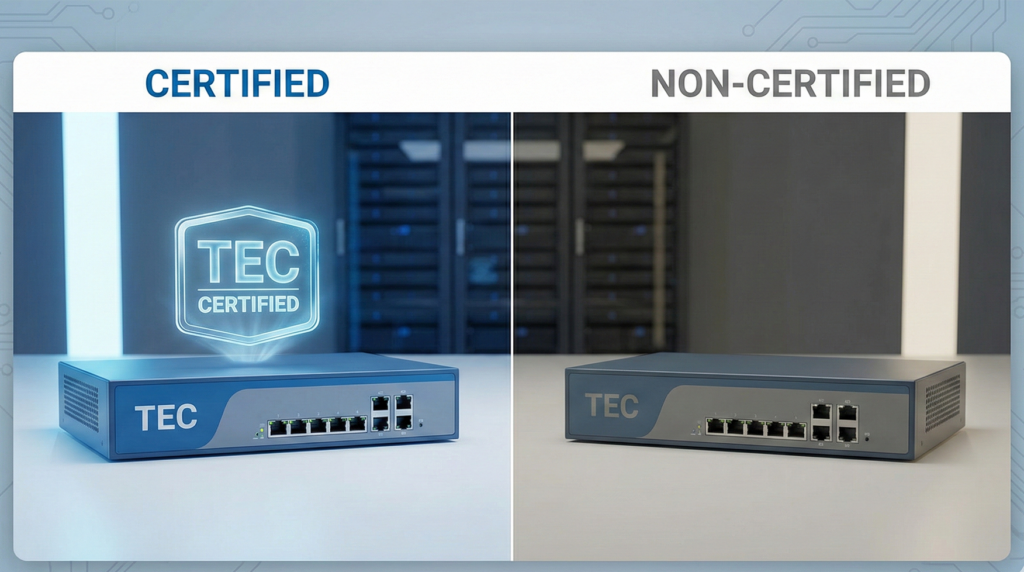
When you’re modernising your organisation’s telephony infrastructure, you face a critical decision: which analog gateway will bridge your legacy phones to your new IP PBX? The market’s flooded with generic FXS gateways from international brands, but there’s a compliance issue that most enterprises don’t discover until it’s too late. India’s telecommunications regulations mandate TEC approval for all network equipment, and the BVS1000 series stands as India’s first and only TEC-approved analog gateway in this category. This isn’t just about ticking regulatory boxes—it’s about choosing professional-grade infrastructure over commodity hardware.
What Makes TEC Approval Mandatory for Analog Gateways in India?
Since the Indian Telegraph (Amendment) Rules of 2017, every telecommunications device connecting to Indian networks must undergo mandatory testing and certification. The Telecommunication Engineering Centre (TEC) under the Department of Telecommunications enforces this through the MTCTE (Mandatory Testing and Certification of Telecom Equipment) framework.
Here’s what catches enterprises off guard: that Grandstream or AudioCodes gateway you’ve been eyeing? Unless it carries a TEC certificate specifically for the Indian market, it’s technically illegal to deploy. The compliance requirements aren’t suggestions—they’re backed by the Telecommunication Act 2023, which includes strict penalties for violations.
The TEC Compliance Factor
TEC certification ensures three critical aspects: your equipment won’t degrade network performance when connected, it meets safety standards for end-users, and radio frequency emissions stay within prescribed limits. For enterprises in healthcare, education, government, or any regulated sector, this isn’t negotiable.
The consequences of non-compliance are severe. Your equipment can be rejected at customs, government tenders automatically disqualify non-certified products, and service providers can legally disconnect non-compliant devices during audits. I’ve seen hospitals scramble to replace entire gateway deployments when they realised their lack of TEC approval invalidated their tender participation.
Why Are Generic FXS Gateways Falling Short?
Walk into any telecom distributor’s office in Delhi or Mumbai, and you’ll find shelves stacked with FXS gateways from AKOM, Matrix, UBIQCOM, and international brands. They all promise the same thing: connect your analog phones to VoIP networks. But the reality beneath those promises reveals significant gaps.
The Certification Gap
Most international FXS gateway manufacturers haven’t bothered obtaining TEC certification for the Indian market. Why? The process is expensive, time-consuming, and requires maintaining an authorised Indian representative. For them, India’s just another market where distributors handle local compliance issues—or don’t.
When you deploy these gateways, you’re essentially betting that:
- Regulatory audits won’t catch you
- Your competitors won’t report non-compliance
- Future government contracts won’t verify certification
- Insurance won’t void warranties for non-certified equipment
That’s a significant risk for professional organisations.
Performance Architecture: Hardware vs Software
Here’s where technical differences become tangible. Generic FXS gateways typically rely on software-based codec processing. Your voice packets get converted through the main CPU, competing with SIP signalling, web interface requests, and management tasks. During peak loads, you’ll notice it—latency spikes, occasional dropouts, degraded voice quality.
The BVS1000 series uses dedicated hardware DSP (Digital Signal Processor) engines. Think of it as having a specialised chef for each dish rather than one person trying to manage an entire restaurant kitchen. Voice processing happens in dedicated silicon, completely independent of system tasks. The result? Consistent sub-60ms latency even when all 32 ports are simultaneously active.
What Are the Most Common Problems with Generic FXS Gateways?
Let me walk you through the issues that plague generic gateway deployments. These aren’t theoretical problems—they’re the support tickets that keep IT teams awake.
DTMF Recognition Failures
Your hospital receptionist tries to transfer a call using DTMF tones. Sometimes it works. Sometimes it doesn’t. This intermittent behaviour stems from how generic gateways handle DTMF relay.
The standard approach uses RFC2833 out-of-band signalling, which should remove the audio tone and send it as data. But software-based implementations sometimes leave fragments of the original tone in the audio stream. The receiving system hears both the data packet and the audio remnant, detecting “227” when someone dialled “27”. For IVR systems, banking applications, or any DTMF-dependent service, this is catastrophic.
BVS1000’s hardware DTMF detection achieves 99.9% accuracy because dedicated DSP circuits handle tone generation and suppression precisely. The in-band audio gets completely muted during DTMF transmission, eliminating double-digit detection.
Echo Problems That Won’t Go Away
Echo on VoIP calls isn’t just annoying—it makes professional communication nearly impossible. The physics are straightforward: acoustic energy reflects from the analog-to-digital conversion point. Your voice travels to the remote party, but some of it bounces back through the hybrid circuit, creating that hollow, delayed repetition.
Software echo cancellation in generic gateways typically handles 16-32ms of echo tail length. That works for local calls with minimal delay. But India’s network infrastructure often introduces 100-150ms round-trip times, especially for calls routing through multiple carriers. Your echo canceller becomes ineffective.
Hardware-based echo cancellation in BVS1000 handles 128ms tail length, complying with ITU-T G.168 standards. This isn’t marketing speak—it’s the difference between echo-free conversations and frustrated users who eventually abandon analog extensions altogether.
Configuration Complexity
Generic gateways require manual configuration for each deployment. You’re filling in SIP server addresses, codec preferences, DTMF modes, dial plans, and trunk settings for every single port. For an 8-port gateway, that’s manageable. For a 200-room hotel needing multiple 24-port units, it becomes a nightmare.
One typo in the dial plan, and rooms 201-224 can’t make outbound calls. The IT team spends days troubleshooting what should’ve been a straightforward deployment.
How Does BVS1000 Solve These Industry-Wide Problems?
BitVoice didn’t just slap TEC certification onto an existing gateway and call it differentiated. The BVS1000 series was engineered specifically for the Indian enterprise market, addressing real deployment challenges.
Zero-Touch Provisioning
Plug in power and network. That’s it. The gateway discovers your BitVoice IP PBX through multicast announcements, downloads its configuration via TR-069, applies settings, and registers all ports. Five minutes from box-opening to dial tone.
For distributed deployments—hospitals with multiple buildings, hotel chains, university campuses—this eliminates weeks of configuration labour. Your technician doesn’t need deep VoIP knowledge. They need basic networking skills and the ability to plug in cables.
Native Ecosystem Integration
When BVS1000 connects to BitVoice IP PBX, it’s not just SIP compatibility—it’s purpose-built integration. CDR records automatically merge into your centralised reporting. Firmware updates roll out from the same management console that handles your IP phones. Call quality metrics feed into unified analytics dashboards.
Compare this to generic gateways, where you’re managing multiple vendor platforms. Your IP PBX has one management interface, your gateways have another, your SIP trunks require third-party portals. Each system requires separate login credentials, different backup procedures, incompatible logging formats.
Professional Voice Quality Features
HD voice support through G.722 codec means your analog phones can deliver 7kHz audio bandwidth instead of the telephone-quality 3.1kHz. For businesses where voice clarity matters—medical consultations, customer service centres, legal advisory—this isn’t luxury; it’s professionalism.
Adaptive jitter buffering handles network variability gracefully. When packet arrival patterns fluctuate due to network congestion, the buffer automatically adjusts between 20-200ms, maintaining conversation flow without introducing perceptible delay.
Which Industries Benefit Most from TEC-Approved Gateways?
TEC compliance isn’t equally critical for every organisation. Let me break down where it matters most.
Healthcare Facilities
Hospitals operate under strict regulatory scrutiny. When NABH or JCI auditors review your systems, non-certified telecom equipment raises immediate red flags. Beyond compliance, healthcare can’t tolerate DTMF failures when doctors are accessing voicemail or nurses are transferring emergency calls.
A 250-bed hospital might have 150+ analog endpoints: bedside phones, nurse stations, emergency phones in lifts and stairwells, department extensions. Replacing these with IP phones costs ₹45-60 lakhs. Six BVS1000-24S gateways preserve that investment whilst enabling modern features like call recording for quality assurance and AI-powered sentiment analysis.
Government and PSU Projects
Every government tender includes mandatory TEC certification clauses. You literally cannot bid without it. The procurement committee won’t even evaluate your technical proposal if the equipment list includes non-certified items.
Universities, government hospitals, PSU headquarters—they’re all bound by these requirements. BVS1000’s TEC approval isn’t just convenient; it’s the difference between participating in these tenders and watching from the sidelines.
Hospitality Sector
Hotels face unique challenges. In-room phones need distinctive ring patterns for guest identification. Integration with property management systems requires reliable DTMF for wake-up calls and billing. Fax machines at the business centre still matter for international guests.
A 200-room hotel using BVS1000-24S gateways spends roughly ₹180 per room for analog connectivity versus ₹2,500+ per room for IP phone replacement. That’s nearly ₹4.6 lakhs saved whilst maintaining familiar guest experiences and PMS integration.
Educational Institutions
University campuses have phones scattered across hostels, classrooms, laboratories, administrative offices, and security posts. These installations often represent decades of infrastructure investment. Emergency broadcast capability to all extensions during crisis situations becomes non-negotiable.
BVS1000 enables campus-wide emergency announcements to analog phones whilst allowing gradual migration to IP telephony for departments with budget availability. The phased approach prevents massive capital expenditure spikes.
What’s the Real Total Cost of Ownership Difference?
Purchase decisions based solely on initial equipment costs miss the broader picture. Let me break down where expenses actually accumulate over a deployment’s lifetime.
Installation and Configuration
Generic gateways demand experienced VoIP engineers for deployment. You’re paying ₹5,000-8,000 per day for specialists who understand SIP trunking, codec negotiation, and dial plan syntax. A distributed deployment across multiple locations means multiply that by site count and days required.
BVS1000’s zero-touch provisioning changes this equation. Your network technician—someone already on staff earning standard IT wages—can handle installations. No specialised training required beyond understanding basic Ethernet concepts.
Ongoing Maintenance
Generic gateways operate as isolated islands. Each firmware update requires manual intervention—download the file, access each gateway’s web interface individually, upload, reboot, verify. For a deployment with eight gateways across different buildings, you’ve just consumed half a day.
BVS1000 gateways receive centralised updates through your IP PBX management console. Schedule the update for 2 AM, and all gateways upgrade automatically. Your maintenance window goes from hours to minutes.
Downtime Costs
When a patient in a hospital ward can’t reach the nurse station because of gateway failure, that’s not just inconvenience—it’s potential liability. When a hotel guest can’t contact the front desk, that’s revenue impact through negative reviews and lost repeat business.
BVS1000’s 99.95% uptime guarantee versus generic gateways’ typical 99.2% represents roughly 35 additional hours of downtime annually. For critical infrastructure, those hours carry costs far exceeding hardware price differences.
How Can You Migrate Without Disrupting Operations?
The fear of migration disruption often keeps organisations stuck with outdated systems. Here’s how BVS1000 enables risk-free transitions.
Phase 1: Parallel Deployment
Install BitVoice IP PBX and BVS1000 gateways alongside your existing telephony infrastructure. Your analog phones continue working exactly as before—same extensions, same dial patterns, same feature access. The difference happens behind the scenes, where calls now route through IP infrastructure.
This phase carries zero end-user impact. Employees, patients, guests—nobody notices anything changed. You’re essentially testing the new system under full production load without risk.
Phase 2: Feature Enhancement
With IP infrastructure operational, start enabling advanced features. Call recording for quality assurance. Real-time analytics dashboards. Integration with CRM systems. Mobile extension capabilities allowing staff to receive desk calls on smartphones.
Your analog phones remain untouched, but they’re now participants in a modern unified communications platform.
Phase 3: Selective IP Phone Rollout
BVS1000 ports freed by IP phone deployments can be redeployed to other facilities or sold in the secondary market. Your investment doesn’t become obsolete; it becomes flexible.
What About Reliability and Support?
Hardware reliability matters less when support infrastructure compensates quickly. But why rely on reactive support when proactive reliability prevents issues?
Hardware Redundancy
BVS1000-24S and 32S models support dual SIP server registration. If your primary IP PBX experiences issues, gateways automatically fail over to backup servers. Calls continue uninterrupted whilst IT addresses the primary system.
Dual Ethernet ports enable network-level redundancy. Connect each port to different switches, and you’re protected against single-point-of-failure scenarios.
Local Support Advantage
International gateway manufacturers route Indian support through distributors or regional partners. Your support ticket gets escalated through multiple layers before reaching engineering teams in different timezones. Resolution takes days.
BitVoice operates from India with local engineering teams. Submit a support ticket at 10 AM, and you’re often discussing solutions with an engineer by afternoon. For critical infrastructure, this responsiveness isn’t luxury—it’s operational necessity.
Why Is Hardware DSP Processing Worth the Investment?
The DSP versus software codec debate deserves deeper examination because it fundamentally impacts voice quality and system capacity.
Software codecs share CPU resources with every other gateway function. During high-load scenarios—maybe all 32 ports handling simultaneous calls whilst the management interface runs reports—CPU cycles become scarce. Voice processing gets delayed. Packets arrive late. Jitter increases.
Hardware DSP processors handle one task: voice signal processing. They don’t multi-task. They don’t wait for CPU availability. They process audio frames in deterministic timeframes regardless of what else the gateway’s doing.
This architectural difference manifests in MOS (Mean Opinion Score) measurements. Generic software-based gateways achieve 3.8-4.1 MOS under typical conditions. BVS1000 consistently delivers 4.3-4.5 MOS even under peak load. That 0.4-point difference represents the gap between “acceptable” and “excellent” voice quality.
Is TEC approval really mandatory for analog gateways in India?
Why don’t international FXS gateway brands have TEC approval?
Can I upgrade from generic FXS gateways to BVS1000 without service disruption?
What causes DTMF failures in VoIP systems?
How much does analog phone replacement actually cost versus gateway deployment?
Does BVS1000 work with IP PBX systems other than BitVoice?
Making the Professional Choice
Generic FXS gateways serve a purpose—connecting analog devices to IP networks at the lowest possible price point. For home offices and very small businesses without regulatory constraints, they’re adequate.
But professional organisations can’t build critical infrastructure on “adequate.” When your hospital’s emergency communication depends on that gateway, when your hotel’s guest satisfaction suffers from poor call quality, when government tender participation hinges on TEC certification—you need professional-grade solutions.
BVS1000 represents India’s first purpose-built, TEC-certified analog gateway engineered specifically for enterprise deployments. It’s not about being marginally better than generic alternatives; it’s about addressing requirements that generic products fundamentally cannot meet.
The compliance advantage alone justifies consideration. The performance benefits—hardware DSP processing, 99.9% DTMF accuracy, 128ms echo cancellation, HD voice support—make it compelling. The ecosystem integration, zero-touch provisioning, and local support transform it from compelling to essential.
For organisations serious about telephony infrastructure that won’t create legal liabilities, operational headaches, or quality compromises, BVS1000 isn’t just superior to generic gateways. It’s the only professional choice.