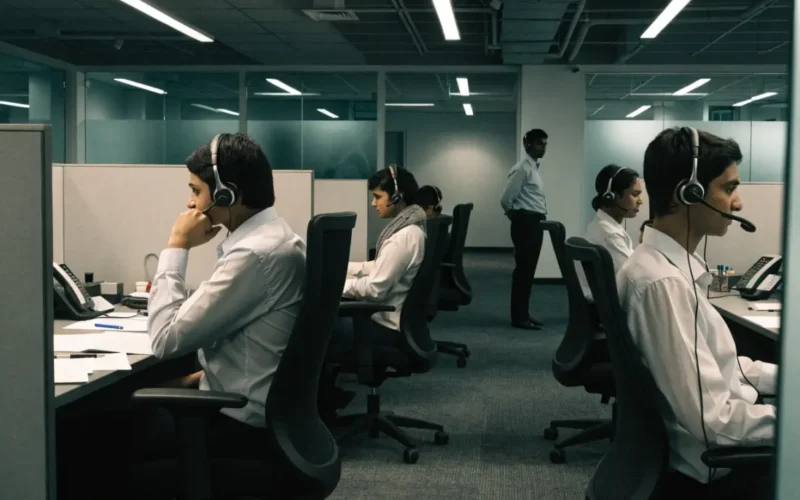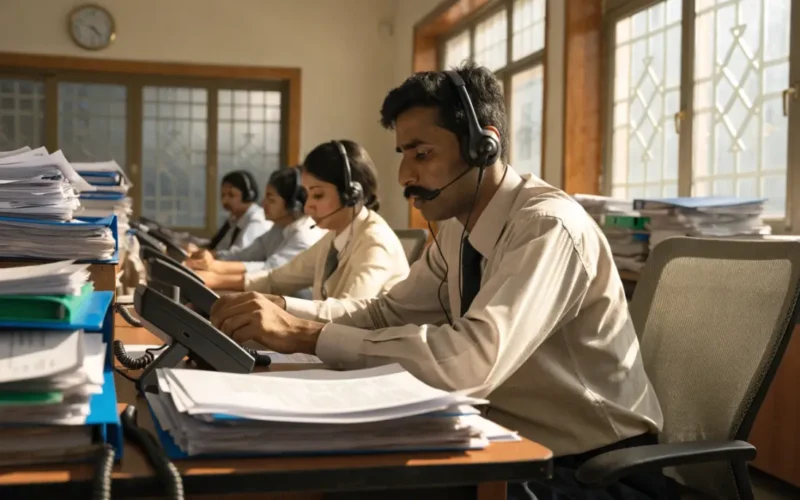
Call centre occupancy tells you how busy your agents really are while they are available to take calls. Utilisation tells you how much of their whole shift goes into handling customers. The two sound alike, are often mixed up in reports, and lead to very different decisions. This guide explains the occupancy formula, the utilisation formula, a worked example for one agent shift, why very high occupancy burns people out, and how to read both figures in Voxdial Contact Center.
Occupancy and utilisation in one line each
- Occupancy is the share of an agent’s available time spent handling contacts: talking, holding and finishing after-call work.
- Utilisation is the share of total logged-in or paid time spent handling contacts, after breaks, training, meetings and other off-phone time are included.
Occupancy is a measure of workload intensity. Utilisation is a measure of how much of the shift is used for customer work. A team can have high occupancy and low utilisation at the same time: very busy while on the phones, but off the phones for a large part of the day.
The formulas
Occupancy = handling time ÷ (handling time + available idle time) × 100
Utilisation = handling time ÷ total logged-in (or paid) time × 100
Handling time is talk time plus hold time plus after-call work. Some centres use paid hours for utilisation and others use logged-in hours; pick one and keep it.
A worked example
One agent works a 9-hour shift with 8 hours (480 minutes) logged in on the agent console.
| Time category | Minutes |
|---|---|
| Logged in | 480 |
| Breaks (lunch and two short breaks) | 60 |
| Team meeting and refresher training | 30 |
| Available for calls | 390 |
| Handling calls (talk, hold, wrap-up) | 330 |
| Available but idle, waiting for the next call | 60 |
- Occupancy = 330 ÷ (330 + 60) = 330 ÷ 390 = 84.6%
- Utilisation = 330 ÷ 480 = 68.75%
The agent was busy for about 85% of the time they were ready for calls, which is a healthy level. Yet less than 70% of the logged-in day went into customer work, because breaks and training took 90 minutes. Both are normal. Problems start when one of them is pushed too far.
Why very high occupancy hurts
It is tempting to treat 95% occupancy as efficient. In practice, when agents go from call to call with almost no gap for long periods, a few things happen:
- Fatigue and stress rise. There is no time to recover after a difficult caller.
- Quality drops. Notes get shorter, dispositions get careless and first call resolution slips.
- Agents create their own breaks. Long wrap-up, extra pauses and unplanned absences go up.
- Attrition increases, and new hires take months to reach full speed.
A common rule of thumb across the industry is to keep sustained occupancy in roughly the 85 to 90% band for inbound voice work. Short bursts above that during a peak are fine; whole weeks above it are not. Very low occupancy, on the other hand, usually means you have more agents logged in than the calls need in that interval.
Occupancy depends on team size
Occupancy is not only a management choice; it follows from your traffic and service level target. Larger teams can run at higher occupancy for the same service level, because calls even out across more people. Small teams need more spare capacity to answer quickly.
In our Erlang C staffing example, 120 calls per half hour with a 4-minute handle time needs 20 agents for an 80/20 service level, which gives 80% occupancy. A team of 5 agents meeting the same service level target on a much smaller queue would run at a lower occupancy, and that is expected, not a sign of idle staff.
So never set an occupancy target in isolation. Decide the service level you need, plan agents for each interval, and let occupancy be the result you watch.
What to do when occupancy is too high or too low
| What you see | Likely cause | What to try |
|---|---|---|
| Occupancy above 90% for most of the day | Too few agents in those intervals | Add people to peak intervals, move breaks, add an overflow group |
| High occupancy, falling FCR and quality scores | Agents rushing between calls | Protect wrap-up time, coach on first call resolution |
| Occupancy under 70% for long periods | More agents logged in than calls need | Move people to callbacks, WhatsApp chats, outbound follow-ups or training |
| Low utilisation, normal occupancy | Too much off-phone time | Review breaks, meetings and paused time with agent status codes |
Low occupancy time is not wasted if you plan it. Callback lists, WhatsApp and Instagram chats in a shared inbox, quality reviews and training can all fill the quiet intervals.
Reading occupancy and utilisation in Voxdial
Voxdial Contact Center shows both views, so name them carefully in your own reports:
- Dashboard occupancy rate: the supervisor dashboard shows an occupancy rate for the centre, described as the share of agents’ logged-in time spent handling calls, alongside service level, abandoned ratio and average handle time.
- Wallboard occupancy gauge: the wallboard shows occupancy against the target you set in Call Center Settings. The settings page itself describes about 85 to 90% as a healthy band.
- Agent Performance report: for each agent over any date range, it lists idle, paused, break, ringing, in call, out call and closure (wrap-up) time, login duration and a utilisation column, and exports to a spreadsheet.
Because every system defines these terms slightly differently, check how each column is calculated before you set targets or compare agents. The time columns in Agent Performance let you rebuild either formula yourself.
For the reports to review each week, see call centre reports. For handle time itself, see average handle time.
Want to see occupancy, utilisation and agent time on your own queues? Talk to BitVoice.
FAQs
What is a good call centre occupancy rate?
For inbound voice, many centres aim for roughly 85 to 90% over a full day. Brief peaks above that are normal, but sustained higher occupancy tends to cause fatigue and lower quality.
What is the difference between occupancy and utilisation?
Occupancy divides handling time by available time only. Utilisation divides handling time by total logged-in or paid time, so breaks, meetings and training lower utilisation but not occupancy.
Why is occupancy lower for small teams?
Small teams need more spare capacity to answer calls quickly, because calls arrive unevenly. For the same service level, a large team can run at higher occupancy than a small one.
Does wrap-up time count in occupancy?
Yes. After-call work is part of handling time, so it raises occupancy. Keep wrap-up short and focused, but do not remove it entirely.