
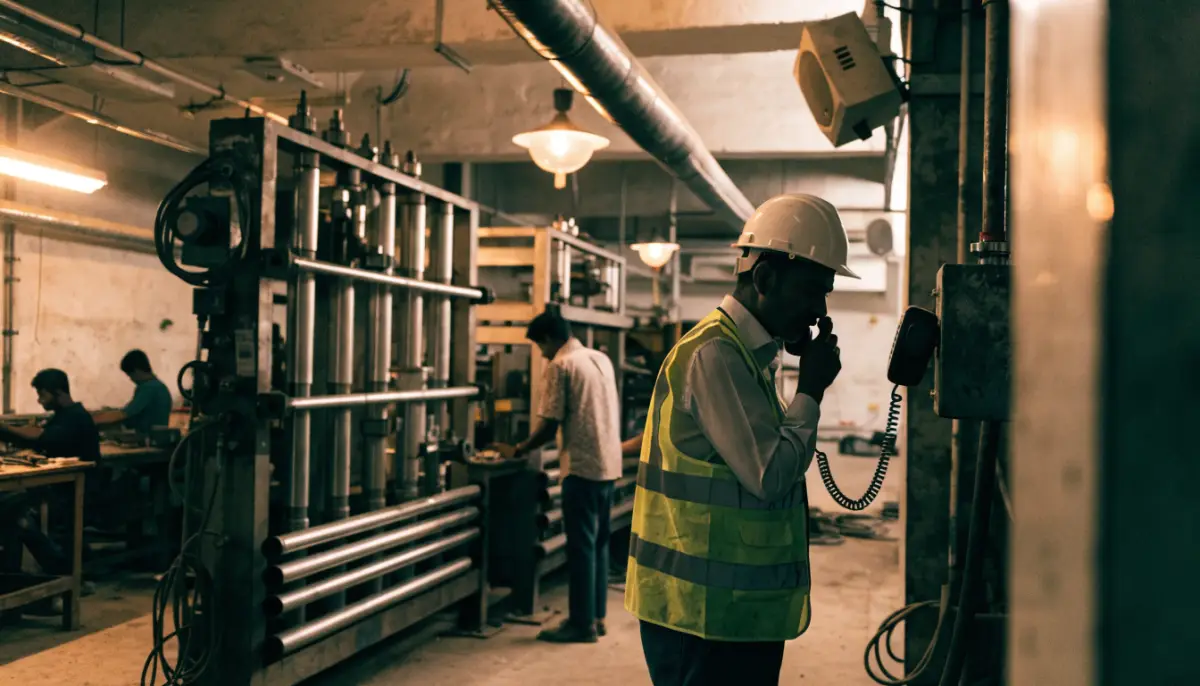
A factory phone system has to work in places an office system never sees: a noisy press shop, a boiler house, a security cabin at the far gate and a warehouse a few hundred metres from the admin block. It also has to carry announcements, raise the alarm in an emergency and link plants in different towns. This guide explains how to plan a phone system for a manufacturing plant, what to keep from your old EPABX, and which features matter most on the shop floor.
What a plant communication system must do
Most plants need the same list, whatever they make:
- A phone in every hall, store, cabin and office, including spots far from the main building.
- Short extension numbers so staff can reach maintenance, stores, quality and security quickly.
- Paging to a hall, a warehouse or the whole site, for shift changes and urgent calls.
- A way to call the safety team at once when an alarm goes off, with a record of who was reached.
- Control over which phones can dial outside, so canteen and floor phones do not run up a bill.
- One system across the head office and every plant, with free internal calls.
- A receptionist or operator who can find people fast and transfer calls.
An IP PBX handles all of this on one platform. Voxdial IP PBX by BitVoice runs on your network, is TEC certified under MTCTE, and is managed from one web console.
Keep the analog phones on the shop floor
Floor phones are usually simple analog handsets on long copper pairs. They are cheap, they survive dust and heat, and nobody wants to rewire a plant to replace them. You do not have to.
An analog VoIP gateway connects those phones to the IP PBX. Each FXS port becomes one extension, and the existing cable keeps working. BitVoice makes the BVS1000 series of analog gateways in 16, 24 and 32 port versions, and they are TEC certified. They support analog runs of up to 3 km on 24 AWG cable, which covers most gate cabins, pump houses and outlying sheds.
Place a gateway near each wiring cabinet, for example one per production block, and link it back to the PBX over the plant network. Use IP phones only where staff need more, such as the plant head’s office, the dispatch desk or the control room. A mix of analog and IP phones on one PBX is normal. The full method is in using analog phones with an IP PBX.
Intercom and short codes
Most factory calls are internal: the line supervisor calling maintenance, stores calling dispatch, security calling the duty manager. Give each department an easy extension and set up ring groups so a call to “Maintenance” rings every phone in the workshop until someone picks up. Follow me can ring a supervisor’s desk phone and then their mobile. See office intercom systems for numbering ideas.
Paging and shift announcements
Many plants still run a separate PA system with its own amplifier room. Voxdial paging uses your network, IP phones and IP speakers, so any authorised user can page a zone from a phone. Set up paging groups by hall, warehouse or block, give the security control room priority so its announcements override routine ones, and use scheduled bells for shift changes and breaks. PA paging is a licensed feature on Voxdial. Read IP paging and PA systems for zone planning.
Emergency alerts
When a fire or gas alarm goes off, paging tells people on site what to do, and an emergency voice alert calls named people on their phones wherever they are. Voxdial’s Emergency Alert module calls everyone in a group, such as fire wardens or plant heads, at the same time with a recorded message, and the alert history shows who answered. That history is useful in safety audits. The emergency alert system guide covers set-up and drills.
Several plants on one system
Plants, depots and the head office can share one numbering plan, so staff dial another site by extension and transfer calls between plants. Either every site registers to one central Voxdial IP PBX, or each plant runs its own PBX linked by SIP trunks, so it keeps working if the link to head office fails. Read multi-branch office phone systems for the trade-offs.
Control calls and costs
Class of service rules decide what each phone can dial. A typical plan:
| Phone | Typical rule |
|---|---|
| Shop-floor and canteen phones | Internal calls only |
| Security cabins | Internal and local numbers |
| Purchase, sales and dispatch | Local, national and mobile |
| Plant head and accounts | National and international |
Rules are built once as templates and attached to each extension. Call detail records then show every outside call by extension and date.
Plan for power cuts
A phone system is only useful in an emergency if it stays up. Put the PBX, network switches and gateways on a UPS, and size it for the time your generator takes to start. Analog phones on a gateway take power from the gateway, so a UPS on the gateway keeps floor phones working. For IP phones, a PoE switch on UPS powers the phones too; see PoE for IP phones.
The service desk side
The same platform can run your dealer and customer service desk, with queues, CRM click to call, WhatsApp chats and calls, and a BitVoice AI voice agent as backup when your team is busy. Read WhatsApp for manufacturers and dealers and see the full manufacturing solution.
Planning a new plant or replacing an old EPABX? Talk to BitVoice for a free site survey.
FAQs
What is the best phone system for a factory?
An IP PBX that keeps analog phones on the shop floor through gateways, adds IP phones where needed, and includes paging, emergency alerts, call restrictions and multi-plant support. In India it should be TEC certified.
Can we keep our existing analog phones when moving to an IP PBX?
Yes. Each analog phone plugs into an FXS port on a BitVoice VoIP gateway and becomes an extension, using the existing cable.
How far can an analog phone be from the gateway?
BitVoice BVS1000 gateways support analog runs of up to 3 km on 24 AWG cable, enough for most gate cabins and outlying buildings.
Can the phone system replace our PA system?
For announcements, yes. Voxdial paging sends announcements to IP phones and IP speakers by zone, with priorities and scheduled bells. PA paging is a licensed feature.