When an office replaces its old EPABX with an IP PBX, the next question is the phones. Should every desk get an IP phone, or can the existing analog phones stay? The honest answer is usually “both”. This guide compares IP and analog phones so you can decide room by room.
How each one connects
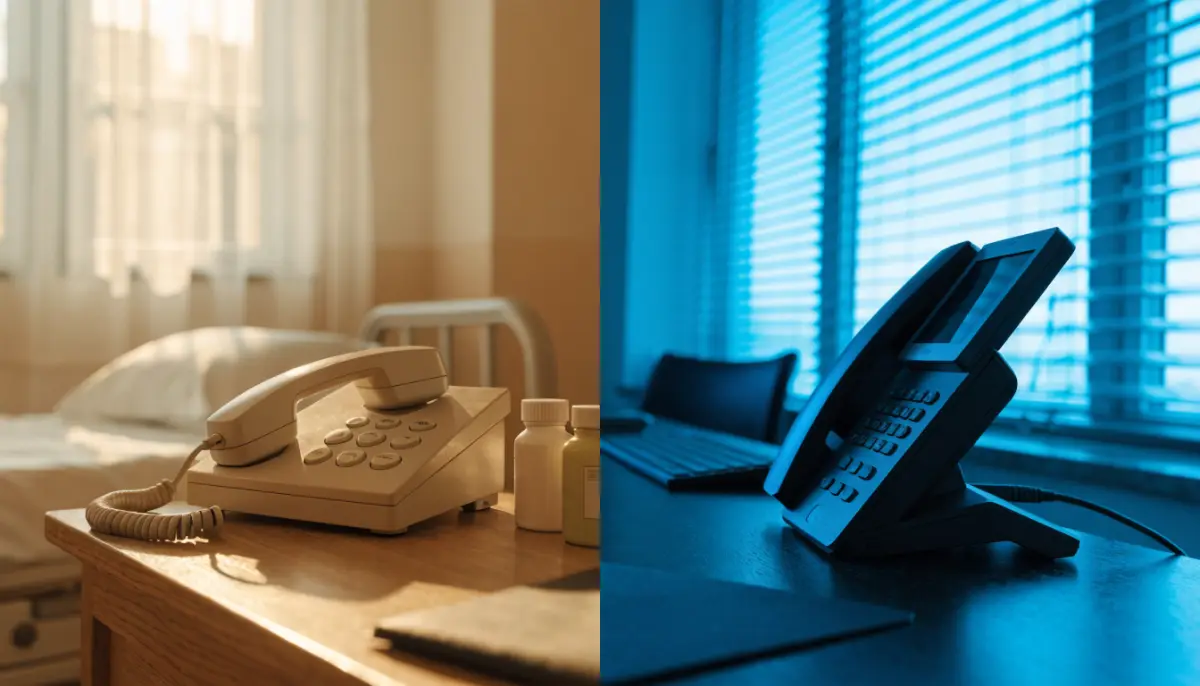
- Analog phone: connects with a two-wire telephone cable to an analog port. On an IP PBX, that port is on an analog VoIP gateway, which turns the phone into a SIP extension.
- IP phone: connects to the office network with an Ethernet cable and registers to the IP PBX directly using SIP.
Side-by-side comparison
| Analog phone on a gateway | IP phone | |
|---|---|---|
| Cabling | Uses existing telephone cabling | Needs a network point (or shares one with the PC) |
| Power | Powered by the gateway over the phone line | PoE from the switch, or a power adapter |
| Sound | Standard telephone quality | HD voice with G.722 or Opus |
| Display | Basic or none | Caller name, call history, directory |
| Features | Dial codes for transfer, pickup, voicemail | Buttons and menus for transfer, conference, BLF, voicemail |
| Lines | One per port | Two or more SIP lines |
| Moves | Re-patch the cable | Plug in anywhere on the network and log in |
| Handset cost | Lowest | Higher |
| Best for | Rooms, wards, factories, lifts, fax | Desks, reception, managers, contact centre |
When analog phones make sense
- Old buildings with telephone cabling but no network points in every room: hospitals, hostels, hotels, factories.
- Long cable runs: analog lines can run much further than Ethernet. The BitVoice BVS1000 supports analog lines up to 3 km.
- Simple, robust phones for wards, store rooms, security cabins and corridors.
- Fax machines, lift phones and alarm diallers, which are analog by design.
- Tight budgets, where replacing hundreds of working handsets would waste money.
When IP phones make sense
- Desks where people transfer, conference and see who is calling.
- Reception and operators, who need line keys and a headset.
- Flexible offices, where staff move desks and log in anywhere.
- New buildings, where structured network cabling already reaches every desk.
The BitVoice B301 is an entry-level IP phone with two SIP lines, HD voice and a PoE variant.
The mixed approach most sites use
Most migrations keep analog phones in rooms and corridors on gateways, and put IP phones on desks and at reception. Both register to the same IP PBX, so users can call, transfer and pick up across both. Over time, analog phones are replaced with IP phones as rooms are rewired.
A note on power cuts
Power cuts are common in many parts of India. Analog phones on a gateway stay up as long as the gateway and PBX are on a UPS. PoE IP phones stay up as long as the network switch is on a UPS. Phones with power adapters at the desk go off when the desk loses power. Plan the UPS before choosing phones.
Not sure what to keep and what to replace? Book a site survey with BitVoice.
FAQs
Can analog phones work with an IP PBX?
Yes. Analog phones connect to an analog VoIP gateway, and each gateway port registers to the IP PBX as an extension.
Are IP phones better than analog phones?
IP phones offer HD voice, a display and more features. Analog phones are cheaper and work over existing telephone cabling. Many sites use both.
Do IP phones work during a power cut?
PoE IP phones work as long as the network switch and IP PBX are on a UPS. Phones with power adapters stop when the desk loses power.
Can I mix analog and IP phones on one system?
Yes. Both register to the same IP PBX, so users can call, transfer and pick up calls across analog and IP phones.